
TL;DR:
Buzzy Today's founder traces his path from college journalist to AI newsroom builder, explaining why he and his team built an agentic "hive" of AI Bees to solve the modern problem of information overload.
Working at The Collegian:
"New England’s Largest College Daily"
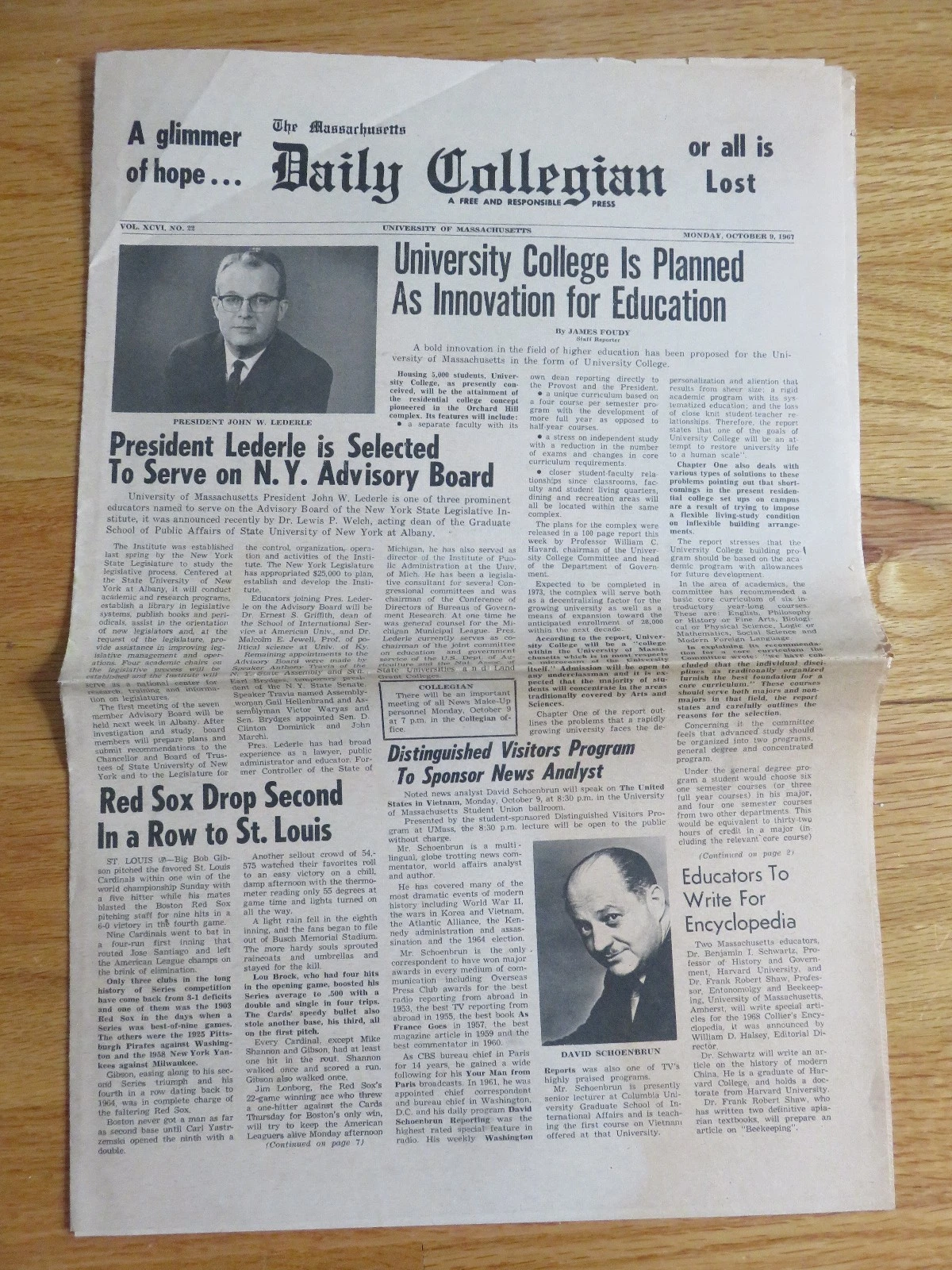
When I was in college I worked at the UMass Collegian. In our masthead we were known as “New England’s Largest College Daily.” I started in IT helping to run the computer systems, although it was mainly a physical operation.
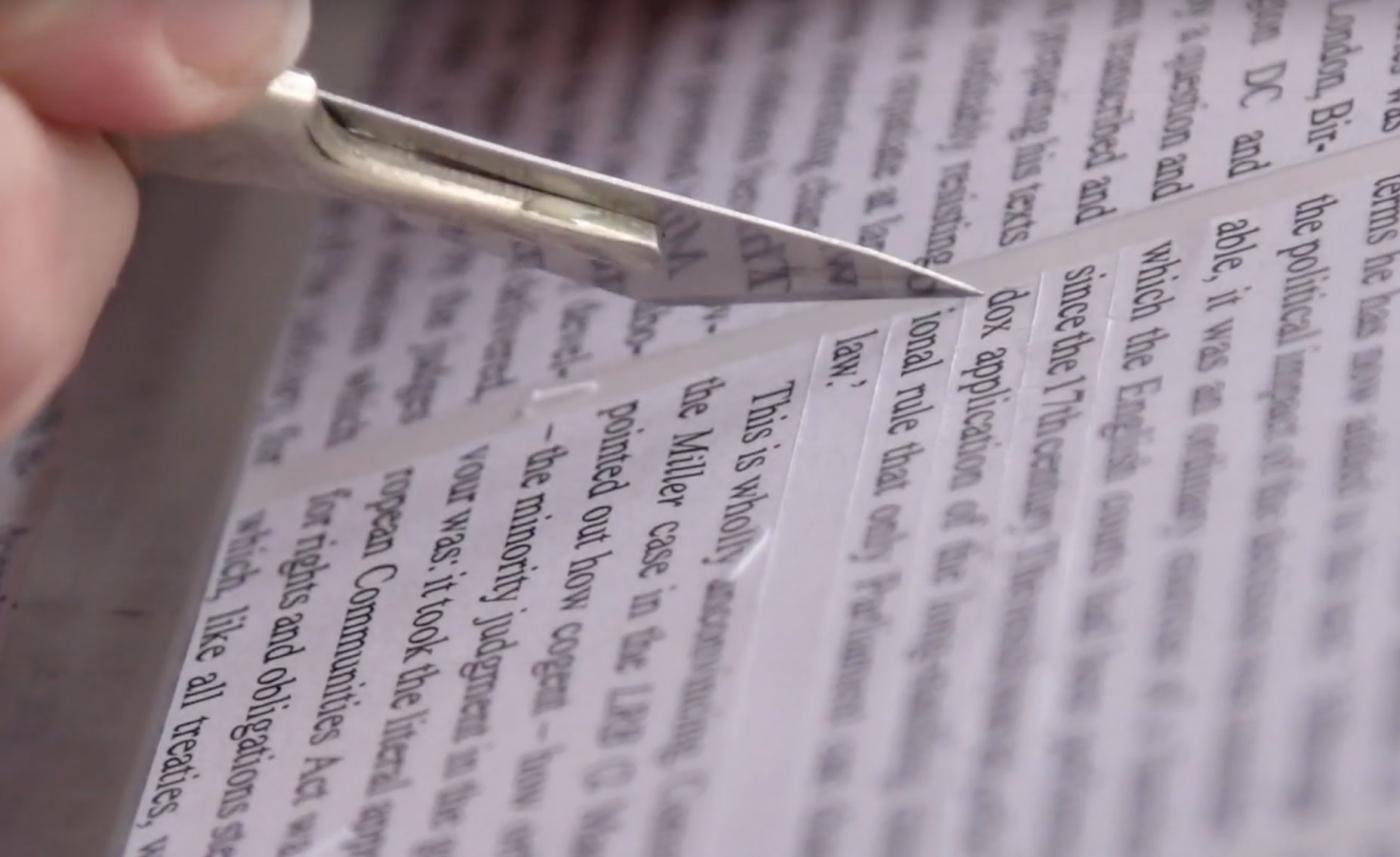
In those days, once a writer finished an article it was sent down to a typesetter, which was a high-end printer. The printed article came out of the typesetter as a long strip of photographic paper called a galley proof. Our Layout Chief Pete would feed each galley proof through a waxer that coated the back with a thin layer of molten beeswax, then cut them into columns with an X-Acto knife. He would then lay each page of the Collegian by hand on a backlit light table, building the edition piece by piece like a puzzle.
The final layouts had to go to the printers by 10pm every night, no ifs ands or buts. One night a reporter didn’t turn in their work on time, and the Editor in Chief asked me to write something (anything!) to fill in the empty column space. I banged out a review of a jazz concert I had gone to the previous evening and suddenly had a new gig.
One article led to another. The Collegian news floor had desks filled with editors who owned different Sections: Front Page, Campus Politics, Events, Sports, Arts, Opinion and Classifieds. Advertisements from local businesses jostled for space with our articles. (Reporters and Advertising both thought the others were parasites.)
I loved writing for the Collegian and the thrill of seeing my name in the byline of an article. Eventually I took on the role of Arts Editor, writing articles and reviewing shows, books, movies and restaurants. I met authors, musicians, artists, local entrepreneurs and speakers. The highlight of my college reporting career was an one-on-one interview with Carl Sagan who had come to UMass Amherst. Working as a journalist literally enabled me to meet people like Dr. Sagan. It opened my eyes to the magic and wonder of reporting information.
The modern day: Overwhelmed and Underinformed
Fast forward 30 years, and we are definitely in a different world. One of the ironies of the modern age is that people are drowning in news, and yet starving for information.
Consider the following:
- In 17th-century England, the average person encountered the equivalent of one newspaper over an entire lifetime.
- 100 years ago, people read an average of 50 books in their lifetime.
- By 1986, the average person read the equivalent of 40 newspapers every single day.
- People now have nearly 5,000 digital interactions every day or 100 gigabytes of sensory-equivalent information.
How times have changed. Today’s modern news landscape is highly fragmented. People can choose from dozens of platforms, each with its own algorithm, narrative and version of events.
This has led to a deep mistrust of the media, with people believing the media is manipulative, chasing clicks instead of facts. People are more confused and anxious, and a polarized world has left people less capable of having a real conversation about what's actually happening in the world.
From a newspaper to a news feed
It’s official: in 2025, more people will use social media than traditional news outlets to get their news and information. This is especially true of younger people aged 18-25 who use social media as their primary source for news and information. However many people feel these social feeds are chaotic and toxic, seeking engagement and a reaction over delivering hard, factual news. The users even know this with 58% of social media users saying they can’t tell fake news from real news.
That’s really a stunning fact: more people are getting their news from a place where they can’t tell if it’s true or not.
Meanwhile, traditional news seems to be losing the race to relevance. Print and legacy digital outlets still do essential reporting. But they're slow, siloed, and increasingly built around subscription walls that fragment the audience further. The newspaper you want to trust can’t always tell you what is happening right now, what you actually care about and connect you with a conversation about it.
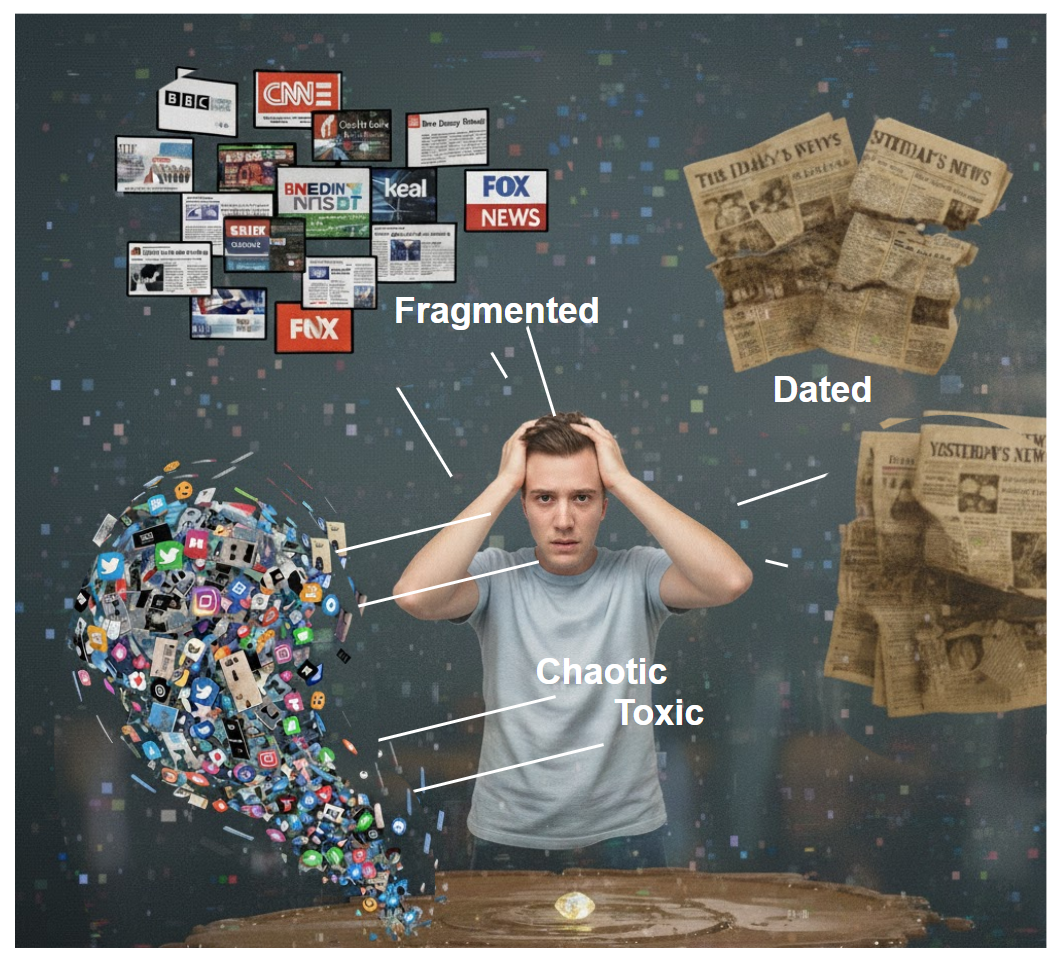
People have told me they feel like they are in the middle of an “information hurricane” but somehow know less about what's actually happening than they did before the internet existed. Our world today is more complex, fast and interconnected than ever before. People don't need more information. They need the right information, fast.
That's the problem we set out to solve with Buzzy Today. Working with my teammates Robert and Faizan we set out to build a next-generation news service that was designed to quickly cut through the noise and deliver information that truly matters to people.
The Buzzy Today Mission
Our core mission with Buzzy Today is simple.
In other words, help people get summaries of the information they care about quickly, and be able to engage with other people interested in the same things. These were both guiding values and engineering requirements as we set out to build Buzzy.
An AI powered newsroom that works for you
I’m going to say this right now: we use AI at Buzzy Today. A lot. AI is incredibly useful, powerful and transformative. We use it to build our systems, tune our algorithms and to power much of the activity in our newsroom. However, we want AI to work for you and to help you (and us) harness the world’s information. So, I’d like to introduce you to my newsroom of agentic “bees” that help the small team at Buzzy Today build a real, live news service.
Listening at Scale : The Listener Bee
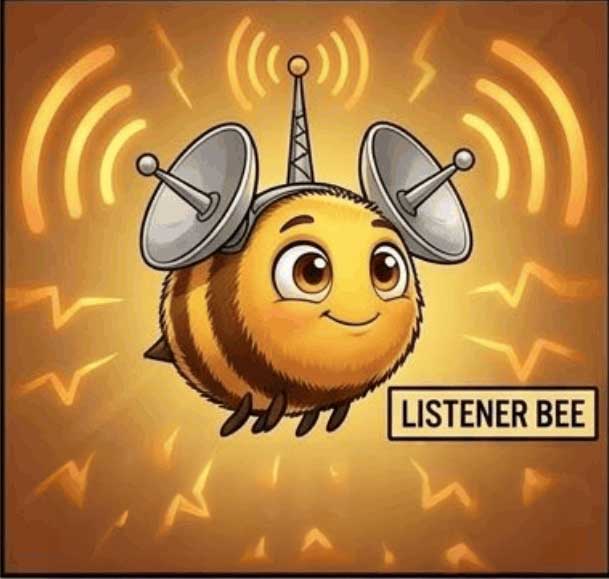
The first challenge is volume, meaning you can’t curate what you can’t hear. We built a “Listener Bee”, not as a product feature but as the answer to a real problem: how do you monitor hundreds of sources, across every section (News, Tech, Sports, Markets, Health, Politics, Entertainment, Science, Lifestyle), without human editors working around the clock? The Listener Bee runs continuously, scanning hundreds of feeds and news services. Everything a reader eventually sees passed through the Listener Bee first which is the literal ears of the newsroom.
Working alongside the Listener Bee is the TrendScout Bee, which takes a more proactive approach. TrendScout looks for breaking news and trends across major internet channels and helps deliver dynamic “Buzzwords” for the Listener Bee to pick up. Our goal is to find breaking and trending stories before readers even know to ask for it. In other words, the Listener Bee waits for the news to come in, while the TrendScout Bee goes out looking for it.
Taxonomy, Tagging and the Problem of Meaning
Listening isn't enough if you can't make sense of what you heard. This is the taxonomy problem. The Buzzy Team came up with a three level structure which is simply:
Section->Category->Topic Tag.
These translate into a Masthead for Buzzy which starts with Sections, then drills down to Articles through Categories and Topic Tags.

The idea here is that every story has a place to live, but also a discovery surface. For example, a story about the LA Lakers is not just a “sports story” It’s also about the NBA and probably LeBron James and the Lakers. That chain of context and meaning is what makes personalization real rather than approximate. A Tagger Bee runs a two-pass system first scores for categorization, then assigns the specific Topic Tags that connect stories to readers. Our goal is to hyper-personalize your feed so it’s exactly news you want to see.
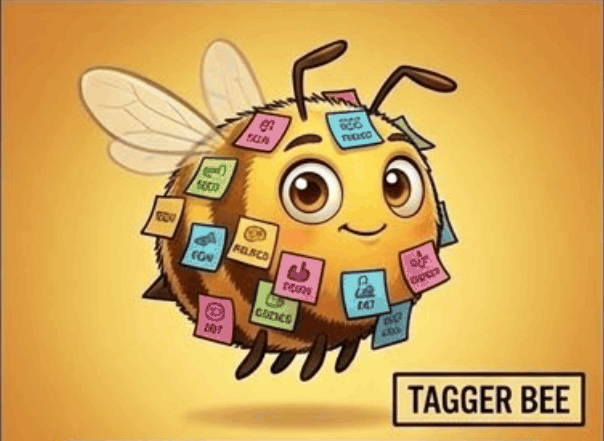
If you follow or ask for a topic tag, Buzzy Today will start to look for information that matches your interest.
Summaries: the problem of time
The other feature we wanted to build into Buzzy Today is a “progressive information” model where users can instantly scan an article and know what it is about. We include a very short TL;DR (Too Long Didn’t Read) summary. Most people don't have 8 minutes for a full article.

The Summarizer Bee is trained on how to summarize different kinds of information at scale. It provides a three-layer summary format: a TL;DR (what happened, in two sentences), Key Takeaways (what to remember), and a context Q&A (the questions a reader would actually ask, answered). The goal isn't compression for its own sake, it’s respecting the user’s time while leaving them informed. In addition, Buzzy Today links to the source article for the user to read at any time.
A personal note: When I was in college, I loved how sports desks wrote: fast and punchy, getting to the point, with a specialized vocabulary that belonged just to the world of sports. In creating the headlines and TL;DR services, we realized that each Section and Category needed a different set of language, tone and style. We’ve tried to make that work with a different kind of summary depending on the type of news you are reading. We will be constantly improving this part of Buzzy Today, so let us know how it works.
Personalization: the problem of relevance
The Buzzy API then builds a customized feed for every reader, powered by the “Personalization Bee.” It looks at topic tags you have followed and weights what you engage with and tries to build a dynamic feed of information tailored for you. Your topic tags will decay over time, so your feed will evolve with you as your interests evolve and you discover new things. You can also edit your topic tags or suggest new ones at any time. We wanted to make this transparent and not a black box, so readers can see why a story showed up and change that if they want.
The Buzzy Take
Every article on Buzzy Today comes with something you won't find in the original source: the Buzzy Take.
The Buzzy Take is a short editorial perspective on the story — what it actually means, why it matters, what's being left unsaid. It's clearly labeled. It doesn't pretend to be neutral. We think that's more honest than the alternative, which is burying a point of view inside "objective" framing and hoping nobody notices.
This was one of the earliest decisions we made and one of the ones we're most confident in. The problem with most news isn't that it has perspective — everything does. The problem is that perspective gets smuggled in rather than declared. The Buzzy Take puts it on the table. You know what you're reading. You can agree with it, push back on it, or ignore it entirely. That's your call. Our job is to be transparent about the fact that we have one.
Three Ways to Read
One of the things we thought hard about was how people actually want to consume news. We think different people may want to read different stories in different ways. Some people want to scan headlines quickly and decide what matters. Others want to go deep on a single story without distraction. And for myself, I still enjoy the old-school newspaper experience. So we built three distinct reading experiences.
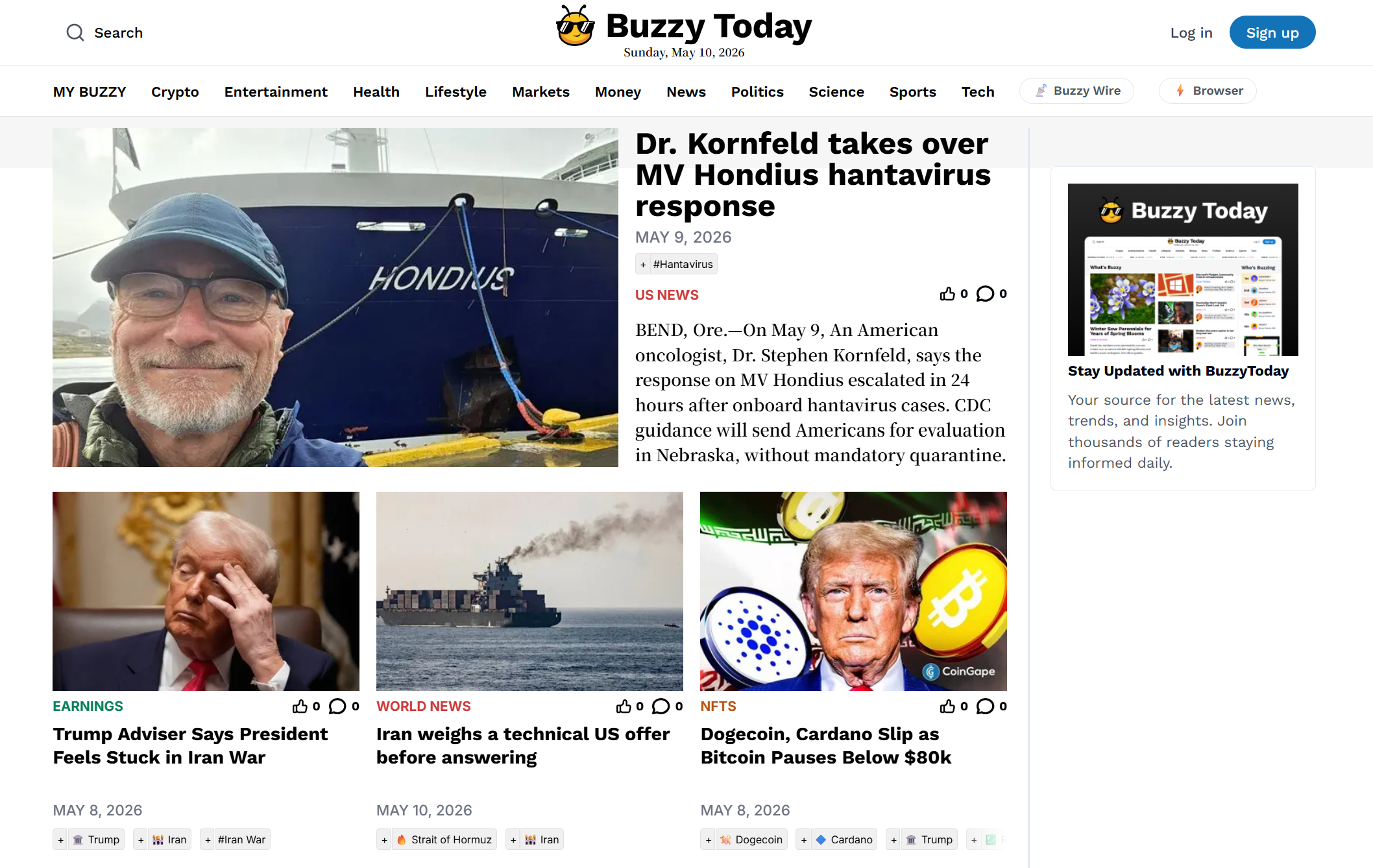
- Newspaper Mode is the default view of Buzzy Today, and is what it sounds like. It should feel to you like flipping through a modern-day digital newspaper that becomes increasingly personalized to your individual interests. We have standardized color coding for Sections and Categories and an emoji-based Topic Tag schema so you always have a visual “feel” of where you are.

- The Buzzy Wire is our version of a live news ticker: a single scrollable page of everything the Buzzy Bees have published, in real time, across every Section. If you want to know what's happening right now across the entire news landscape, the Buzzy Wire is where you go. This was an experiment from our labs that we decided to include in the launch. It's the difference between a curated newspaper and a bustling newsroom floor, basically when you want the newsroom floor.
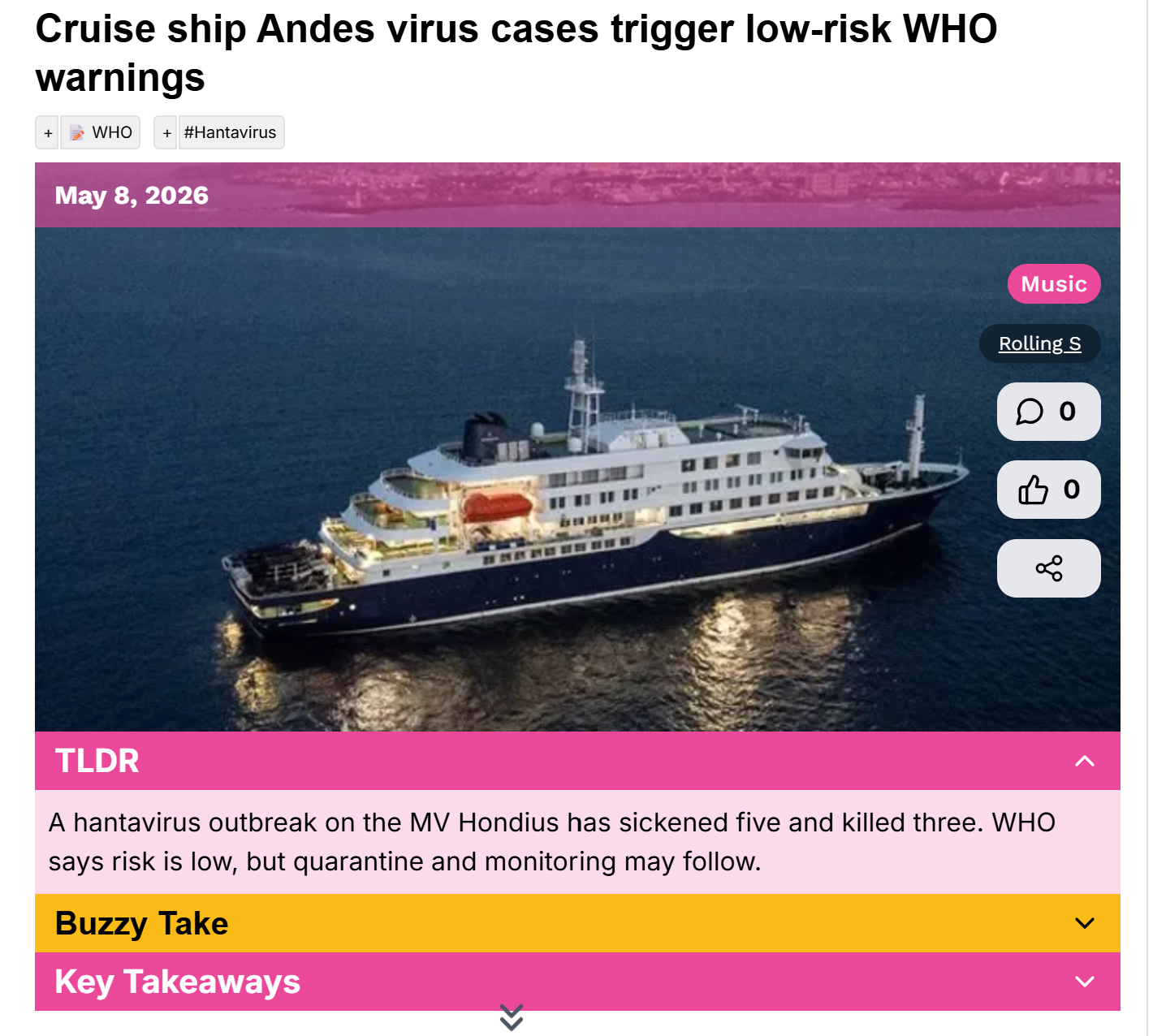
- Buzzy Browser is our focused reading mode: one article at a time, full screen, no clutter. Think of it like flipping through a magazine that was assembled just for you. You swipe through stories, each one presented cleanly with its TL;DR, Key Takeaways, and the Buzzy Take front and center. There are no sidebars pulling you somewhere else, no related articles engineered to keep you clicking. You can swipe "vertically" through a personalized feed or a Section or Category, or “horizontally” through different Sections. So you read the story and then decide what comes next. It’s a deliberately calm experience that enables focused ingestion of information. It’s a mobile-first experience, designed for the way people like to consume content on their phones, e.g. one at a time without distraction.
Collectively, Newspaper Mode, Buzzy Wire and the Buzzy Browser reflect a principle we kept coming back to, namely that readers should be in control of how they consume, not just what they consume.
The Daily Buzz
One of the things I missed most about working at the Collegian was the daily rhythm of it. We started working at 4pm, collecting the day's stories and filling our allotted column space. By 8pm, everything got to Pete in layout. By 10pm it was off to the printers. At 7am the next morning a fresh, new edition of the Collegian populated every dormitory, dining hall and class building on campus. The daily news had a shape, a beginning, a middle and an end with some context to tie it together.
That feeling is almost entirely gone from how people consume news today. The feed and the news cycle never end. There's no “cutoff” with an editor deciding that's enough for today, here's what mattered.
We wanted to bring that back. So every day, Buzzy Today uses a team of specialized worker bees to publish The Daily Buzz.
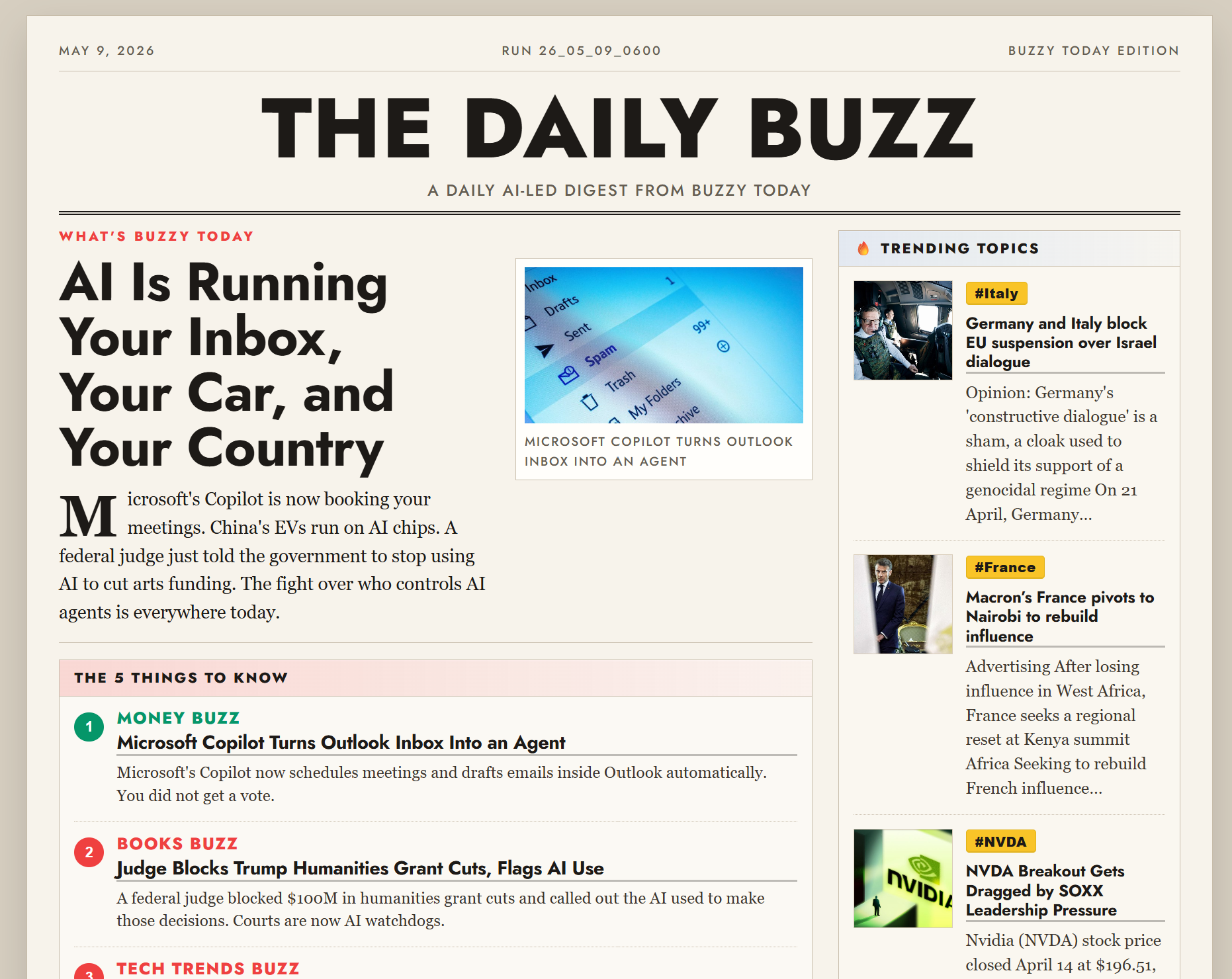
It starts with the Fetcher Bee, which assembles the day's top stories from everything Buzzy Today has processed in the past 24 hours. This can be the most-read stories, or the most-discussed or stories that TrendScout Bee flagged as breaking. This raw material goes to an Editorial Bee, which does what a good editor does: finds the thread connecting the day's news, decides what the lead is, and structures the digest so it reads like a coherent edition rather than a list of links.
From there a Writer Bee writes the actual copy, based on what the Editor Bee thinks is important. Then the Newsletter Bee does what good old Pete did at the Collegian: lay everything out and produce a daily. We have an Artist Bee that produces the visual assets such as headline cards formatted for different platforms, because the same story needs to look different on email than it does on Instagram. Then we have a Social Bee who prepares all of the stories for distribution, translating the day's digest into the right format for each channel. What works on X doesn't work on LinkedIn, and neither works on a newsletter.
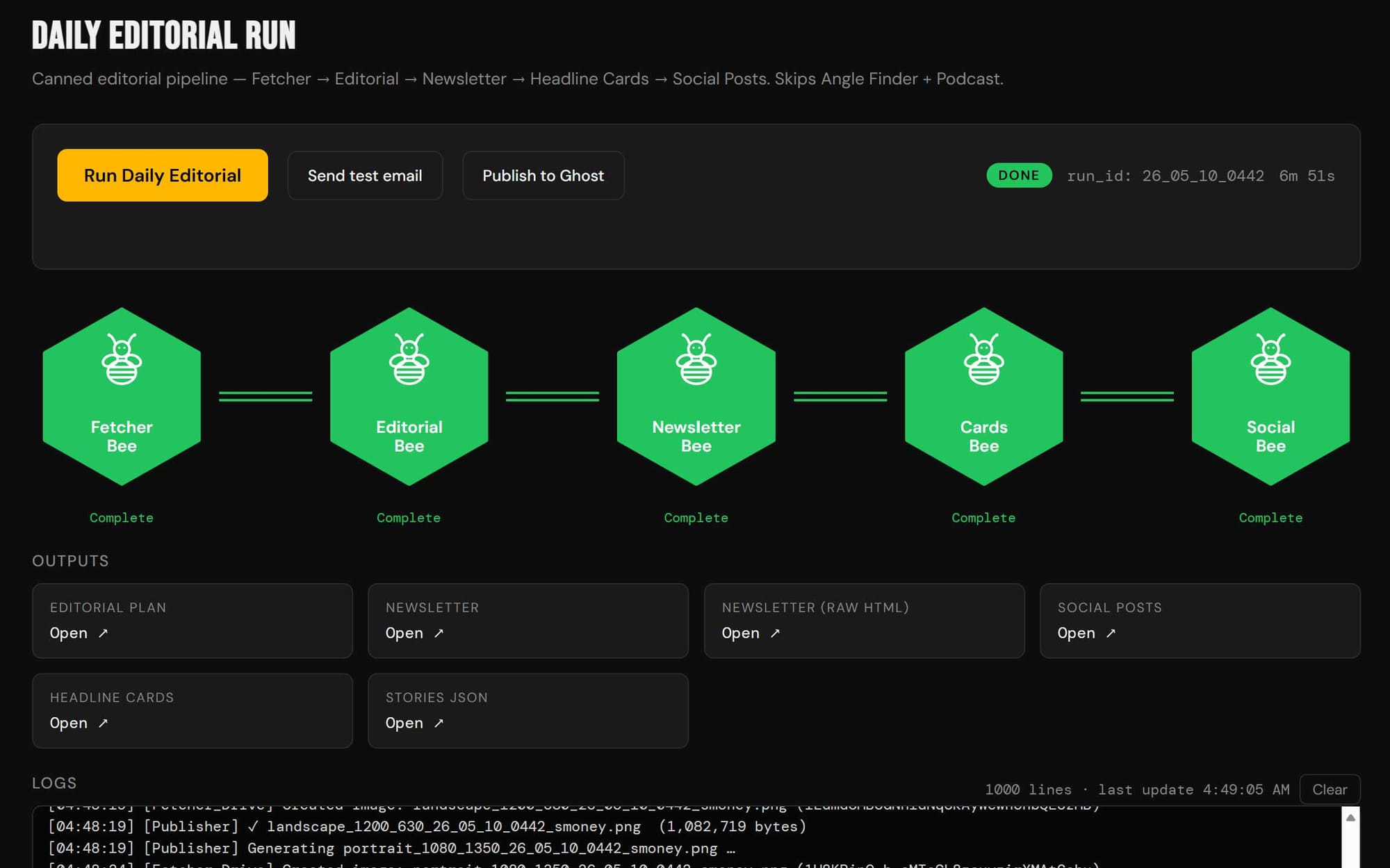
This whole pipeline, from raw data to a clean, formatted Daily Buzz in your inbox, runs without a human touching it. That still impresses me and is a testament to the quality of the Buzzy API that we wrote to access the news data that streams out of the Buzzy Today platform, and the agentic platform we've assembled underneath.
We are also working on a Daily Buzz podcast version, hosted by three “talent Bees” Max, who jumps on breaking news and doesn't hide when something is alarming; Jake, who slows things down and gives you the analysis; and Flora, who keeps it from taking itself too seriously.
One of our biggest goals with the Daily Buzz is to not sound like AI, and to produce something people actually want to read. The Daily Buzz is at a slightly different URL www.buzzy.today (vs. www.buzzytoday.com for the Buzzy Today news service) so you can let us know how we did.
The best voices rise.
We also built a comments section, but we're hoping it becomes something more than that.
I’ve always felt comments on the internet have a reputation problem that’s not entirely deserved. The worst comment sections can be cesspools because the platforms that host them are optimized for volume and reaction, i.e. getting a reaction as opposed to actual quality. But arguably some of the best (and funniest) writing on the internet lives in comment threads. Reddit is a great example of this, where the comments are truly the content. I’m hoping similar voices can emerge and shine through on Buzzy Today.
We built our community layer to try and highlight the best comments. Comments at Buzzy Today are treated as a signal layer: readers who add real context, expertise, or perspective get surfaced. The noise doesn't disappear, but the goal is for it to stop winning.
Human Bee-ings

There are also humans in the loop at Buzzy Today; meaning our team and our readers. We actively monitor categorization, story quality, accuracy, tone, style and bugs. We have a feedback button built into many areas of the site and we want to know what isn't working.
Our readers play an equally critical role. The comments section enables real voices to be heard and surfaces articles that actually matter to people. And we're planning to open Buzzy Today to reader contributions such as local news, opinion pieces, and other kinds of information that don't make it into the mainstream feed. The Hive gets better when more people are inside it.
An Invitation
Buzzy Today has been nearly two years in the making, and it's open right now - for everyone, for free. It’s still “beta” in many ways but it was time to launch, and the best way to build something worth reading is to have real readers inside it. There are features we're still building, sources we're still adding, things we'll get wrong and fix. That's not a disclaimer, that’s just how it works. A news and information product needs to be constantly improving and updated.
Thousands of articles are moving through Buzzy Today right now, and many of them are stories you would never find on a platform that’s busy showing you what made people mad yesterday. Our goal is to have our busy worker bees produce a feed around the topics you actually care about.
News without the noise. Built around you.
Come on in!
Buzzy Take:
Every media company says it's fighting information overload. Most of them are causing it. What makes this manifesto worth reading isn't the product, it's the rare founder who can trace a straight line from an old school college newspaper, through a wax roller and a light table, to an agentic newsroom. The problem with news isn't that nobody cares. It's that nobody built a better filter. Buzzy Today is a serious attempt at one.